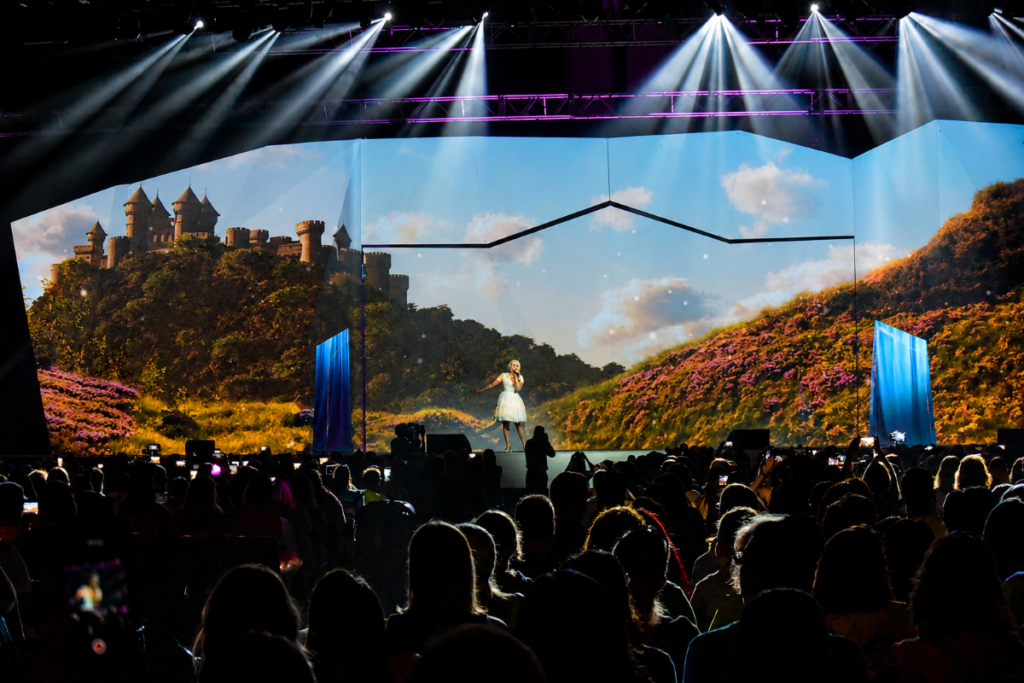
Ask a planning team to picture the high point of good corporate event production, and most people picture the reveal: the drone show, the gasp, the one moment everyone replays on the flight home. That instinct captures something real, but it skips the part of the work that makes the peak possible.
Curiosity earns attention. Deep engagement turns attention into memory. Awe turns memory into value that nothing else can create. Skip a step, and the next one starts from zero.
The Short Version
- Curiosity opens the room — novelty and a bit of mystery keep people leaning in from the first minute to the last.
- Trust decides what a speaker can skip — a room that already believes needs less convincing from the stage.
- Deep engagement carries the event — the work in between opening and closing happens more often than any single peak moment.
- Awe depends on what came before it — the payoff only reads as earned when the groundwork under it is visible.
- Sequence beats spectacle — corporate event production works when curiosity and engagement come before the reveal, not after.
Curiosity Opens the Room for Any Audience Engagement Strategy
Curiosity is the baseline state that keeps a room leaning in, driven by novelty and just enough mystery to stay interesting. It has to carry through the entire event, opening minutes included — lose it before the close and the final moment won’t do what it’s supposed to, because nobody will still be listening.
Curiosity has one prerequisite worth naming. People who feel safe will forgive a speaker almost anything. People who don’t will punish even a good one for trying too hard. Safety, in a room full of employees or clients, comes from what happened before anyone picked up a microphone.
What Sales Meetings Production Looks Like in Practice
At a national sales meeting for a retail client, the opening was built around a single physical set piece: a full-scale train, long enough for attendees to walk its length, anchoring a “full steam ahead” theme for the year. It stayed on the floor for the entire event, a landmark people kept returning to.
The client’s chief of stores had 30 to 45 minutes of prepared remarks ready to open the meeting. He got up, looked at a room that had just spent 10 minutes with something they clearly loved, and cut almost all of it. He didn’t need to convince anyone. They already believed, and belief people feel outlasts belief they’re told.
Deep Engagement Drives Employee Experience Events
Most of the work in strong employee experience events happens in deep engagement, not at the peak. The train did that job for the whole meeting, something people kept returning to until it stuck. This layer happens far more often than awe does across an event, and it carries just as much weight.
Awe is the reason for the climb. It works as the summit of an event, earned by everything built underneath it. A well-run audience engagement strategy is what makes that summit possible: chase the peak without the climb, and the result is a loud moment that doesn’t connect, aimed at a room that was never warmed up to receive it.
Corporate Event Production for Leadership Meetings and Summits That Earn the Reveal
This is the sequencing problem corporate event production solves. The work is about staging curiosity first, sustaining engagement through the middle of the meeting, and only then asking a room to be moved. Leadership meetings and summits that skip straight to the reveal are asking an unprepared audience to do work the production should have done first.
The proof shows up on-site: a chief of stores folding up his notes on stage because the trust was already in the room before he picked up his microphone.
Questions Worth Asking
How much of corporate event production happens before the big reveal?
Most of it. The curiosity and trust that make a reveal work get built earlier, in planning, staging, and the flow leading into it. Without that groundwork, the reveal has nothing to rest on.
Why does audience engagement matter before the keynote even starts?
Sustained engagement work happens throughout an event, and it’s what people return to and act on. It carries most of the weight, even when a single peak moment gets the credit.
What role does trust play in a leadership moment like a keynote?
Audiences who feel safe forgive an imperfect delivery; audiences who don’t will punish even a strong one for trying too hard. Trust built earlier changes how every later moment gets received.
How early should curiosity and engagement get built into event planning?
Ideally at the same stage as the agenda itself, so it’s built in from day one. An engagement layer added late tends to feel bolted on rather than integrated.
How Ansera Builds the Climb Before the Peak
Ansera builds corporate event production around this sequence: curiosity first, deep engagement sustained throughout, and awe treated as the earned peak rather than a moment bolted onto a flat agenda. That sequence runs through Ansera’s live event production and brand event work, with technical direction keeping the pacing controlled enough for the trust-building to register.
Awe starts here. Let’s Talk.
While You’re Here
3 Ideas for Large Corporate Events to Improve Engagement