Why Large-Scale Event Networking Fails (And a Framework to Fix It)
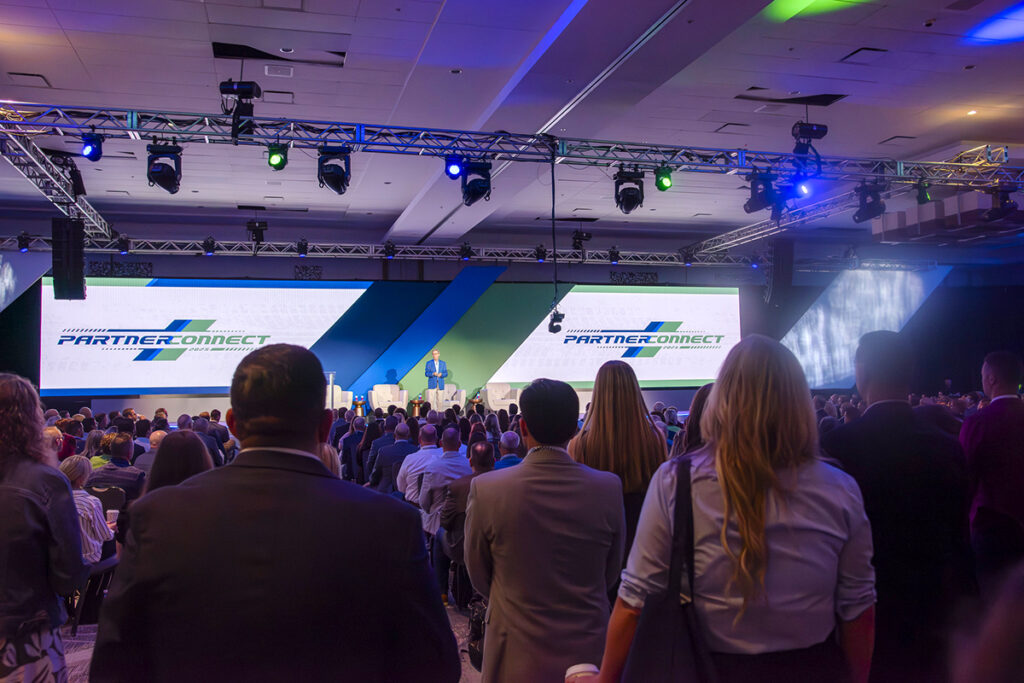
Event networking is consistently ranked as one of the top reasons people attend professional conferences. It’s also consistently one of the lowest-rated outcomes in post-event surveys. At MPI World Education Congress, we designed and demonstrated a framework to fix that, live, with 1,000+ attendees in the room.
Here’s a question worth asking before your next large-scale event:
If connection is a stated outcome on your program, what have you actually designed to make it happen?
For most events with hundreds or thousands of attendees, the honest answer is: a cocktail hour and a hope.
The gap between intention and outcome isn’t a mystery — it’s a design failure. And it’s one that’s entirely fixable.
The Short Version
- Large-scale event networking succeeds when it’s designed deliberately, but most programs leave it to chance.
- Proximity creates opportunity; it doesn’t create connection.
- Most large-scale networking fails due to three structural mistakes: relying on proximity, optimizing for quantity, and siloing networking as a standalone agenda item.
- Meaningful connection requires shared context, structured conversation, and intentional design.
- The four-layer framework below can be woven through an entire event program — not just dedicated networking blocks.
The Three Structural Mistakes That Kill Large-Scale Event Networking
Mistake 1: Leaving proximity to do the work
The most common networking “design” is putting people in the same room and assuming connection will follow. It won’t. Proximity creates opportunity. It doesn’t create connection. Without structure, most people default to the people they already know, the people who look like them, or the people standing nearest to the bar.
At scale, this problem compounds. In a room of a thousand people, the social math is overwhelming. Without a structured entry point, most attendees won’t make a single meaningful new connection — regardless of how much they wanted to.
Mistake 2: Optimizing for quantity over quality
Speed networking, business card exchanges, meet-your-table exercises — these formats prioritize volume. They can produce a long list of names that no one remembers two weeks later.
Meaningful conference networking isn’t about surface contact. It’s about shared context, genuine curiosity, and the sense that the other person actually sees you. That requires time, structure, and intentional conversation design — not efficiency.
Mistake 3: Treating networking as a standalone agenda item
When networking is siloed — a dedicated block between sessions, a reception after the keynote — it signals to attendees that it’s separate from the event itself. Something to do when the real content is over.
The most effective networking at large events is woven through the agenda. It happens inside sessions, during transitions, in the designed gaps between content. It’s not a room you walk into — it’s the throughline of the experience.
“Proximity creates opportunity. It doesn’t create connection.”
A Framework for Intentional Large-Scale Networking
At MPI WEC, we led a session called Networking Goes Big, where we walked 1,000+ attendees through a scalable framework for designing intentional event networking at large events. The session didn’t just teach the framework — we demonstrated it live. By the end, every person in the room had made at least three new, meaningful connections using the exact techniques we’d just described.
Here’s the core of what we shared:
Layer 1: Pre-connection context
Before people walk into a networking environment, give them shared context that makes conversation easier. A provocative question they’ve all considered. A framework they’ve all been introduced to. A common experience they’ve just had together. Shared context dramatically lowers the social friction of approaching a stranger.
Layer 2: Structured conversation design
Don’t ask people to network — give them a specific, time-bounded task with a clear starting point. “Find someone you’ve never met and answer this question together” is infinitely more actionable than “mingle.” The structure creates permission and removes the anxiety of the cold approach.
Layer 3: Escalating depth
Design networking moments at your event in sequence — shallow first, deeper second. A 90-second first exchange, followed by a five-minute structured conversation, followed by an open-ended continuation. Each layer makes the next one feel earned rather than forced.
Layer 4: Re-entry design
The hardest moment in any networking environment is the second one — when you need to leave a conversation and start a new one. Design an explicit re-entry mechanism so attendees can move without the social awkwardness of extracting themselves from a perfectly good conversation.
What This Looks Like in Practice
These four layers can be applied across a full-day live event production program — not just in dedicated networking blocks. Pre-session questions become layer one. Structured peer conversations inside sessions become layer two. Facilitated small-group moments during transitions become layer three. Deliberate agenda pacing creates space for layer four.
The result: an event where connection is designed, not wished for. Where attendees leave with relationships, not just business cards.
Get the full Networking Goes Big framework and session resources from MPI WEC.
→ Download the MPI Session Resources
EJ Corporan is Director of Marketing & Research at Ansera, where he leads experience strategy, thought leadership, and the Science of Awe research platform.
While You’re Here
What Your Attendees’ Heart Patterns Can Tell You About Your Event Design