Audience Engagement Strategy for Enterprise Events: How to Move Beyond Passive Participation
Participation is easy to manufacture at scale. Engagement is harder. The difference between a room full of people going through the motions and a room that’s genuinely present is a design question with a strategic answer.
One clarification before we go further: active participation and genuine engagement are not the same thing. Answering a poll, raising your hand, joining a breakout are participation mechanics.
Engagement is the quality of presence underneath them. A room in total silence, fully absorbed in what’s happening on stage, can be more engaged than one furiously responding to prompts. The question is how to produce an audience engagement strategy that brings that quality of presence at scale, reliably, by design.
The Short Version
- Participation and engagement are related but distinct. A strong audience engagement strategy targets the latter.
- At enterprise scale, the conditions that keep people present don’t occur naturally. They have to be built.
- The emotional arc of an event belongs in a strategic document.
- Environmental design (staging, lighting, acoustics) does measurable psychological work before anyone takes the stage.
- Overall satisfaction scores won’t tell you which moments worked.
What Enterprise Events Demand
Small events have natural engagement built in. Proximity, eye contact, visible reactions: these create feedback loops that keep people present without any deliberate design. At enterprise scale, that changes.
Three things break down as event size grows:
- Proximity disappears. The audience in the back third of a ballroom has a fundamentally different sensory experience than the first few rows. Distance dissolves the physical cues that create presence.
- The feedback loop breaks. Speakers and producers can no longer read the room in real time. The signals that prompt adjustment — a visible energy shift, a restless crowd — stop being visible.
- Sensory experience fragments. Without intentional live event production design, a large-format event produces engagement for the people closest to the action and passive attendance everywhere else.
What restores presence at scale is awe. Research published in Psychological Science found that awe sharpens focus, heightens emotion, and makes experiences significantly more memorable. At enterprise events, those effects have to be designed for. They don’t emerge from size or spectacle alone.
Building an Audience Engagement Strategy That Works at Scale
The emotional arc
Every event asks something of its audience. The arc determines whether they’re ready to give it.
Every enterprise event has an agenda. Fewer have an emotional arc.
An agenda sequences content. An emotional arc sequences feeling: curiosity before conviction, tension before resolution, individual reflection before collective action. The sequence in which people feel things determines how receptive they are to what comes next. An enterprise event engagement strategy built around an emotional arc starts with one question: what do we need the audience to feel differently about when this is over? The agenda builds backward from that.
The role of environment
The room is doing something before anyone takes the stage.
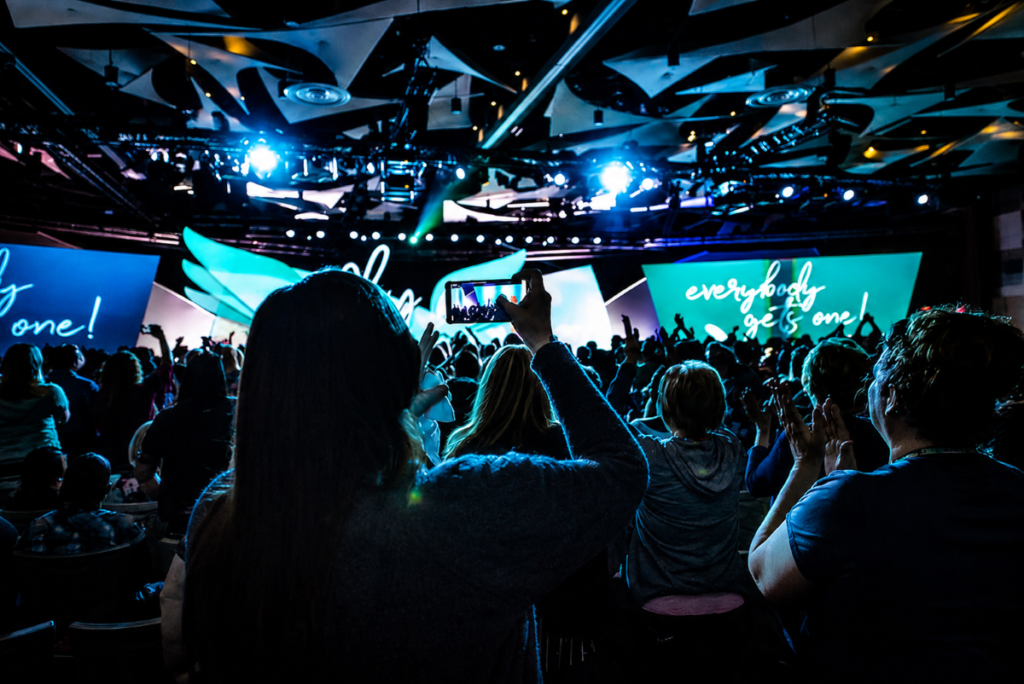
Staging depth, sightlines, lighting temperature, acoustic design: these variables shape attention and emotion before a single word is spoken. Research by Dacher Keltner and Jonathan Haidt identifies physical vastness as a core trigger of awe. At enterprise events, the physical environment is often the largest lever available. A production environment with genuine scale, controlled atmosphere, and intentional spatial design creates conditions where the content registers differently.
Technical direction is a front-of-house strategic decision.
Sequencing high-intensity moments
The moments that move people are almost never the ones that were expected to.
Audience attention across a multi-hour event peaks, drops, and recovers in predictable patterns. A strong audience engagement strategy maps those patterns and places its highest-intensity moments where energy is most at risk of dipping, not uniformly distributed across the program.
What counts as high-intensity varies by audience. For some groups, it’s a speaker revelation. For others, it’s a physical environment shift, a piece of video production that reframes everything that came before it, or a silent moment that holds longer than expected. The format is secondary. The psychological effect is the target.
Hybrid as a parallel experience
The remote audience is the hardest corporate event engagement problem to solve — and the most often treated as an afterthought. A genuine hybrid event strategy designs separate but intentional experiences for each audience, with deliberate connection points between them. When the design is right, the two audiences reinforce each other. When it’s wrong, the room dilutes both.
How to Approach Audience Engagement Measurement
Standard post-event surveys aggregate too broadly to inform event audience engagement planning. “How would you rate the overall experience?” returns a number that can’t tell you which moments worked and which didn’t.
Useful measurement requires moment-specific questions: What do you remember most clearly from the main stage? Was there a point where something shifted for you? Observable signals during the event — physical stillness at high-stakes moments, the quality of conversation during breaks — confirm what surveys later quantify. Teams building a corporate event ROI framework around engagement track both.
Questions Worth Asking
When should audience engagement planning enter the process?
Before the agenda is finalized. Session length, sequencing, and format decisions directly constrain what’s possible in the production. The two have to develop together.
Does engagement strategy differ across event types?
The emotional targets change. An incentive event is calibrated differently than a leadership summit. The design process, and the questions it starts with, are the same.
How do you maintain engagement across a multi-day event?
Vary intensity deliberately. Day two benefits most from an unexpected opening rather than a recap. Rebuilding momentum from zero is harder than sustaining it.
What separates engagement from participation in practice?
Participation is observable: hands raised, polls answered, seats filled. Engagement is the quality of presence behind those actions. The test is whether people leave with something they didn’t have coming in — a belief, a connection, a memory that holds.
Let’s Craft Awe Together
Ansera builds enterprise events around the science of engagement — from the emotional arc to the production environment to the moments that make a room feel like one.
Dig Deeper